
Loading docks are one of the busiest areas of any warehouse, distribution center, or manufacturing facility. From receiving incoming shipments to preparing outgoing orders, having the right loading dock equipment helps keep materials moving safely and efficiently.
However, not every loading dock has the same requirements. Differences in truck heights, facility layouts, available space, and material handling needs all play a role in selecting the right equipment.
Whether you're upgrading an existing loading area or designing a new dock, here's what to consider when choosing the right loading dock equipment for your facility.
1. Evaluate Your Loading Dock Requirements
Before selecting equipment, take a closer look at how your loading dock operates. Consider the types of vehicles that regularly visit your facility, the volume of shipments you handle, and how materials are moved between trucks and the building.
Start by asking a few questions:
-
What types of trucks and trailers use your loading dock?
-
Are truck bed heights consistent or do they vary?
-
Do employees use forklifts, pallet jacks, or other material handling equipment?
-
How frequently are trucks loaded and unloaded?
-
How much available space is there around the dock?
These factors will help determine which equipment is best suited for your operation.
2. Choose the Right Dock Leveler
Dock levelers help bridge the height difference between a loading dock and a truck or trailer. They create a transition surface that allows forklifts, pallet jacks, and other equipment to move between the facility and the vehicle.
There are several types of dock levelers to consider.
Edge-of-Dock Levelers
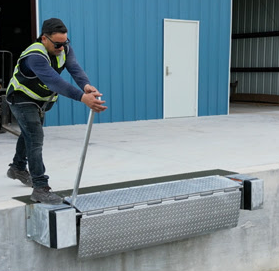
Edge-of-dock levelers are mounted directly to the face of the loading dock. They provide a practical solution for facilities that need to accommodate relatively consistent truck heights without installing a larger recessed leveler.
They are commonly used for:
-
Facilities with limited dock space.
-
Lower-volume shipping and receiving operations.
-
Applications with relatively consistent trailer heights.
Recessed Dock Levelers
Recessed dock levelers are installed into a pit within the loading dock floor. Their design allows the leveler to sit flush with the dock surface when not in use.
Benefits include:
-
Accommodating a wider range of truck heights.
-
Providing a permanent loading dock solution.
-
Supporting frequent loading and unloading operations.
-
Integrating into existing dock layouts or new construction.
Vertical Dock Levelers
Vertical dock levelers are designed to store in an upright position when not in use. They are often selected for facilities that prioritize dock cleanliness, environmental separation, and controlled loading areas.
Consider your truck traffic, loading requirements, and facility design when choosing a dock leveler.
3. Determine Whether You Need a Dock Plate or Dock Board
Not every loading dock requires a permanent dock leveler. For certain applications, dock plates and dock boards offer a simpler way to bridge the gap between a loading dock and a vehicle.
Dock Plates
Dock plates are generally made from aluminum and are designed for lighter-duty loading applications. They are commonly used with pallet jacks, hand trucks, and other manually operated equipment.
Dock Boards
Dock boards are typically constructed from steel and designed for heavier-duty applications. Many are equipped with safety curbs and forklift entry features.
When comparing dock plates and dock boards, consider:
-
Maximum load capacity.
-
Width and length requirements.
-
The equipment traveling across the plate or board.
-
The height difference between the dock and truck.
Always verify that the selected product is rated for the total load, including the weight of the material handling equipment and its cargo.
4. Consider Dock Lifts for Different Loading Heights
Some facilities do not have traditional raised loading docks, while others need to accommodate trucks and vehicles with varying bed heights.
Dock lifts provide a platform that raises and lowers materials to the appropriate loading height. They can be particularly useful for facilities that need more flexibility than a traditional dock leveler provides.
Recessed Dock Lifts
Recessed dock lifts are installed into a pit in the floor, allowing the platform to sit flush with the surrounding surface when lowered. They are useful for facilities that need a lifting solution without permanently occupying valuable floor space.
Surface-Mounted Dock Lifts
Surface-mounted dock lifts are installed directly on the floor and can provide a lifting solution when a recessed installation is not practical.
When selecting a dock lift, consider platform dimensions, lifting capacity, vertical travel, and how materials will be loaded and unloaded.
5. Protect Your Loading Dock with Bumpers and Wheel Chocks
Loading dock protection equipment helps protect your building, vehicles, and surrounding equipment during loading and unloading operations.
Dock Bumpers
Dock bumpers absorb impact when trucks back into the loading dock. They help reduce damage to the building structure and truck trailers.
Common options include:
-
Molded rubber dock bumpers.
-
Laminated dock bumpers.
-
Steel-faced dock bumpers.
-
Heavy-duty dock protection systems.
Wheel Chocks
Wheel chocks are placed against vehicle tires to help prevent unwanted movement while trucks are parked at the dock.
Selecting appropriate dock protection equipment can help reduce unnecessary damage and support safer loading dock operations.
6. Improve Weather Protection with Dock Shelters and Seals
Loading docks are exposed to outdoor conditions throughout the year. Rain, wind, snow, and temperature changes can affect the loading area and the products being handled.
Dock shelters and dock seals help create a barrier between the building and the trailer during loading and unloading.
Dock Seals
Dock seals use compressible foam pads to form a seal around the rear of a truck or trailer. They are commonly used when facilities receive vehicles with relatively consistent dimensions.
Dock Shelters
Dock shelters provide a covered enclosure around the trailer opening. They offer flexibility for facilities that accommodate different trailer sizes.
These products can help:
-
Reduce exposure to outdoor weather.
-
Limit drafts and unwanted air exchange.
-
Protect products during loading and unloading.
-
Improve environmental control around the dock.
7. Don't Overlook Dock Safety Equipment
A well-equipped loading dock should also include products designed to help protect employees and prevent accidents.
Depending on your facility, consider:
-
Dock gates: Help restrict access to open dock positions when trailers are not present.
-
Truck restraints: Help secure trailers during loading and unloading.
-
Safety barriers: Help separate employees and equipment from hazardous areas.
-
Dock lights: Improve visibility inside trailers and around loading areas.
-
Handrails: Provide additional protection around elevated platforms and dock areas.
The right combination of safety equipment depends on your facility's layout and operational requirements.
Find the Right Loading Dock Equipment at A Plus Warehouse
Choosing the right loading dock equipment starts with understanding your facility's needs. From dock levelers and dock lifts to dock plates, bumpers, shelters, and safety equipment, every component plays a role in creating an efficient loading and unloading operation.
A Plus Warehouse offers a wide selection of loading dock equipment for warehouses, distribution centers, manufacturing facilities, and shipping operations.
Check out our Dock Equipment!